

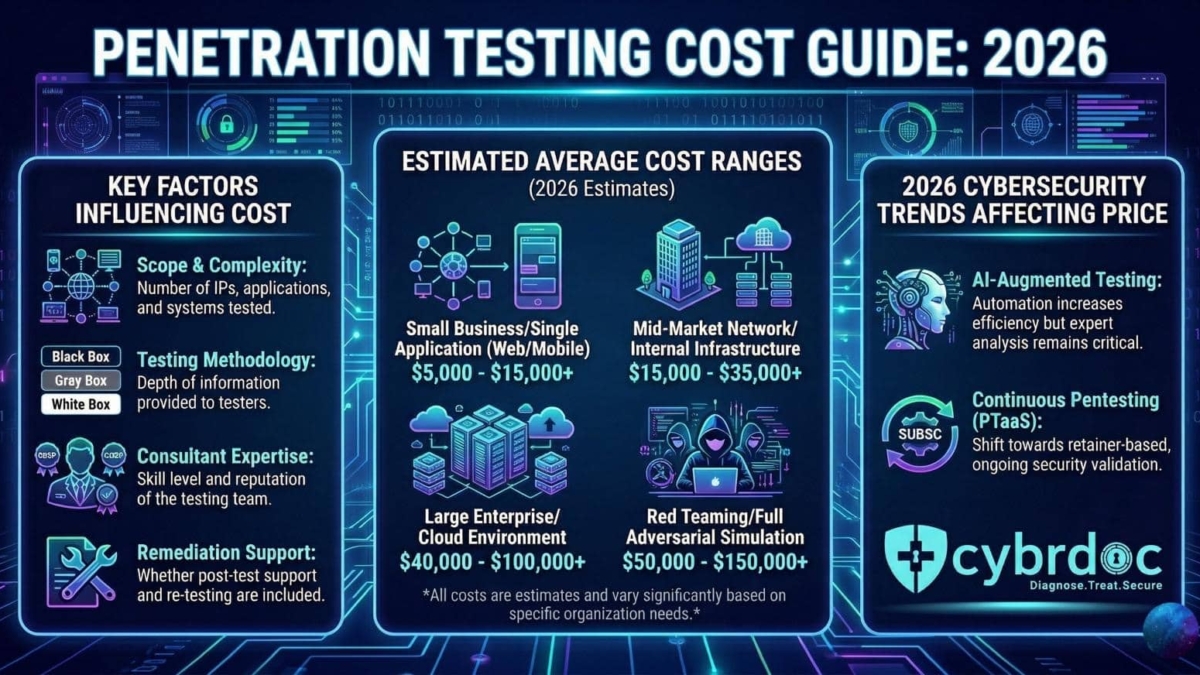
How much does penetration testing cost? It is one of the most common questions small business owners ask before hiring a cybersecurity company — and one of the least transparently answered online. Most cybersecurity firms hide their pricing behind “contact us for a quote,” leaving businesses guessing whether penetration testing costs £500 or £50,000.
In this guide, CybrDoc breaks down the real penetration testing cost in 2026 — by test type, scope, methodology, and business size — so you can budget accurately and make an informed decision before you hire anyone.
What Affects Penetration Testing Cost?
Penetration testing cost varies significantly depending on several factors. Understanding these variables helps you evaluate quotes accurately and avoid overpaying for coverage you do not need.
Scope of the engagement is the biggest cost driver. A pen test covering one small web application costs far less than a test covering an entire corporate network, multiple servers, cloud infrastructure, and mobile apps simultaneously. The broader the scope, the more time the tester needs, and therefore the higher the penetration testing cost.
Type of penetration test also significantly affects pricing. A web application pen test follows a different methodology than a network pen test or a social engineering assessment. Each type requires different tools, expertise, and time investment.
Testing methodology matters too. Automated scanning tools are fast and cheap but miss complex vulnerabilities. Manual penetration testing by a certified professional takes longer but finds vulnerabilities that automated tools cannot. Most reputable providers combine both — and charge accordingly.
Tester credentials and experience directly affect penetration testing cost. A tester holding certifications commands higher rates — and delivers more reliable results — than an uncertified tester.
Location and market also plays a role. Penetration testing rates in Australia and the US tend to be higher than rates in India and Southeast Asia, though quality varies considerably regardless of geography.
Penetration Testing Cost by Type in 2026
Here are honest price ranges for each major type of penetration test, based on current market rates for small and medium businesses.
Web Application Penetration Testing
Web application penetration testing is the most common type for small businesses. It covers your website, customer portal, login pages, APIs, and web-based applications.
Typical penetration testing cost: $500 – $5,000 AUD / ₹30,000 – ₹2,50,000
The lower end covers a simple brochure website or single-page application with basic functionality. The higher end covers complex web applications with multiple user roles, payment processing, APIs, and large amounts of sensitive data. Most small business web application pen tests fall between $800 and $2,500 AUD.
Network Penetration Testing
Network penetration testing covers your internal network infrastructure, servers, firewalls, routers, and connected devices. It simulates an attacker who has already gained access to your network — testing whether they can escalate privileges and reach critical systems.
Typical penetration testing cost: $1,500 – $8,000 AUD / ₹75,000 – ₹4,00,000
External network pen tests (testing internet-facing systems) sit at the lower end. Internal network pen tests (simulating an insider threat or breach) cost more due to the time and access required.
Mobile Application Penetration Testing
Mobile app pen testing covers your Android or iOS applications, testing for insecure data storage, broken authentication, insecure API calls, and reverse engineering vulnerabilities.
Typical penetration testing cost: $1,000 – $4,000 AUD / ₹50,000 – ₹2,00,000
Social Engineering Assessment
Social engineering testing evaluates your employees’ susceptibility to phishing emails, phone-based attacks (vishing), and physical security breaches. This type of test is often undervalued but reveals critical human vulnerabilities that technical tests miss.
Typical penetration testing cost: $800 – $3,000 AUD / ₹40,000 – ₹1,50,000
Cloud Security Assessment
Cloud security assessments cover your AWS, Azure, or Google Cloud environment — checking for misconfigured storage buckets, overly permissive IAM roles, exposed APIs, and insecure network configurations.
Typical penetration testing cost: $1,500 – $6,000 AUD / ₹75,000 – ₹3,00,000
Full-Scope Penetration Test
A full-scope engagement combines web application testing, network testing, social engineering, and cloud assessment into one comprehensive programme. Large organisations and those with compliance requirements typically commission these.
Typical penetration testing cost: $5,000 – $30,000+ AUD / ₹2,50,000 – ₹15,00,000+
Penetration Testing Cost by Business Size
To make these ranges more practical, here is what businesses of different sizes typically spend on penetration testing.
Solo founder or micro business (1-5 staff, simple website) A basic web application pen test covering your main site and any customer-facing forms. Focus on OWASP Top 10 vulnerabilities and common attack vectors. Realistic budget: $500 – $1,200 AUD / ₹25,000 – ₹60,000
Small business (5-25 staff, e-commerce or client portal) Web application testing plus a basic external network assessment. Covers your website, payment processing, and any cloud storage. Realistic budget: $1,500 – $3,500 AUD / ₹75,000 – ₹1,75,000
Growing SMB (25-100 staff, internal systems, multiple applications) Comprehensive web and network testing, potentially including social engineering and cloud assessment. Often driven by compliance requirements. Realistic budget: $4,000 – $10,000 AUD / ₹2,00,000 – ₹5,00,000
Enterprise or compliance-driven (100+ staff, regulated industry) Full-scope annual programme covering all systems, applications, and infrastructure. Realistic budget: $10,000 – $50,000+ AUD / ₹5,00,000 – ₹25,00,000+
What Is Included in a Professional Penetration Test?
Understanding what penetration testing cost covers helps you evaluate whether a quote represents good value. A professional pen test from a certified provider should include all of the following.
Pre-engagement scoping: A discovery call to define exactly what systems are in scope, the testing methodology, rules of engagement, and what constitutes a successful test.
Reconnaissance: Passive information gathering about your systems, domain, and publicly available data before active testing begins.
Active testing: The actual exploitation attempts — scanning for vulnerabilities, attempting to exploit them, and documenting every finding with evidence.
Reporting: A detailed written report covering every vulnerability found, its severity rating (Critical, High, Medium, Low), step-by-step reproduction instructions, and specific remediation recommendations.
Remediation guidance: A professional tester should be available to answer questions about the report and guide your team through fixing the issues found.
Retest (sometimes included): Some providers include a free retest after you have remediated findings, to confirm the fixes are effective. Always ask whether retest is included before signing.
If a provider offers penetration testing without a written report, without remediation guidance, or without any scoping discussion — treat that as a red flag regardless of the penetration testing cost quoted.
Automated Scanning vs Manual Penetration Testing: The Cost Difference
Many businesses confuse automated vulnerability scanning with manual penetration testing. Furthermore, some providers sell automated scans at manual pen test prices — which is worth understanding.
Automated vulnerability scanning uses tools like Nessus, Qualys, or OpenVAS to scan your systems and report known vulnerabilities. It is fast, cheap ($50-300 AUD per scan), and useful for identifying obvious issues. However, automated tools cannot chain vulnerabilities together, cannot perform logic-based attacks, cannot test for business logic flaws, and cannot simulate what a real attacker would do with the access they gain.
Manual penetration testing by a certified professional does all of those things. Additionally, a skilled tester finds vulnerabilities that automated tools consistently miss — particularly in web applications, authentication systems, and complex business logic. Manual testing is therefore more expensive but significantly more valuable.
For small businesses on a tight budget, the most cost-effective approach is a combination: run automated scanning first to identify and fix obvious issues cheaply, then commission a manual pen test to find what the automated tools missed. This approach maximises the value of your penetration testing cost.
Red Flags That Indicate Poor Value
Not all penetration testing providers offer equal quality. Watch out for these warning signs when evaluating quotes, regardless of penetration testing cost.
No mention of certifications or methodology. Any credible provider should clearly state whether their testers holds equivalent credentials.
Unusually low pricing. A comprehensive web application pen test for $150 is not a bargain — it is an automated scan with a “pen test” label. Quality manual testing takes time, and time costs money.
No scoping call. Reputable providers always want to understand your environment before quoting. A provider who quotes instantly without asking questions is almost certainly offering automated scanning.
No sample report. Ask for a sanitised sample report before hiring. A good pen test report is detailed, technical, and actionable. A poor one is a list of scanner output with no context.
No remediation support. Discovering vulnerabilities is only half the value. The other half is understanding how to fix them. Providers who disappear after delivering the report are not worth hiring.
How CybrDoc Approaches Penetration Testing Cost
At CybrDoc, we believe penetration testing cost should be transparent, fair, and proportionate to what small and medium businesses actually need.
Our vulnerability assessment and penetration testing service is delivered by Robin Vashisht — a certified ethical hacker with a Master’s degree in Cybersecurity from Monash University. Every engagement includes proper scoping, manual testing methodology, a detailed written report, and remediation guidance.
We do not use penetration testing as a loss leader to upsell unnecessary services. We assess what your business genuinely needs, recommend only that scope, and price it accordingly.
If you are unsure what type of penetration test your business needs or what a realistic budget looks like for your specific situation, contact us for a free consultation. We will assess your environment, explain exactly what we recommend and why, and give you a transparent quote with no surprises.
Frequently Asked Questions About Penetration Testing Cost
How often should a business get a penetration test? Most security frameworks recommend annual penetration testing as a minimum. Additionally, you should commission a pen test whenever you make significant changes to your systems, launch a new application, or move infrastructure to the cloud. Businesses subject to compliance requirements like ISO 27001 or PCI DSS may need more frequent testing.
Is penetration testing tax deductible? In most jurisdictions, penetration testing costs are deductible as a business expense since they are a professional service directly related to protecting your business operations. Consult your accountant for advice specific to your situation and location.
What is the difference between a vulnerability assessment and a penetration test? A vulnerability assessment identifies and catalogues security weaknesses but does not attempt to exploit them. A penetration test goes further — a certified tester actively attempts to exploit vulnerabilities to determine real-world impact. Penetration testing therefore costs more but delivers deeper insight. Many businesses benefit from starting with a vulnerability assessment before commissioning a full penetration test.
Can I do penetration testing myself? Basic automated scanning is something any business can do using free tools. However, manual penetration testing requires significant expertise, specialised tools, and certifications. Attempting to manually pen test your own systems without the right skills risks missing critical vulnerabilities and potentially causing system instability. Professional penetration testing delivers results that self-assessment cannot replicate.
Does penetration testing cost more for regulated industries? Generally yes — regulated industries like healthcare, finance, and legal services often require more comprehensive testing to meet compliance requirements, which increases scope and therefore cost. Furthermore, testers working in regulated industries may need familiarity with specific frameworks like HIPAA, PCI DSS, or ISO 27001, which can also affect pricing.
Written by Robin Vashisht — Cybersecurity Expert, MSc Cybersecurity (Monash University), Founder of CybrDoc CybrDoc provides professional penetration testing and cybersecurity services for small and medium businesses in Australia, India, and worldwide.
Add a Comment